

La p谩gina que intenta visitar s贸lo est谩 disponible en ingl茅s. 隆Disculpa!
The page you are about to visit is currently only available in English. Sorry!


探花精选 Conservation Biologist Aimee Tomcho spent the past few weeks stalking a tiny songbird through the steep hills of Yancey, Madison, and Ashe counties in western North Carolina. Using mist nets strung through the underbrush, Tomcho and her colleagues captured Golden-winged Warblers and outfitted seven with tiny radio trackers, strapped snugly to their rumps.
The devices, known as nanotags, will give researchers an unprecedented look into the movements of this rare bird, which is imperiled across much of its range. In southern Appalachia, Golden-wing populations have declined as much as 98 percent since 1966.
鈥淭his project will be revelatory for the species,鈥� Tomcho says. 鈥淚t will give us a much more complete migratory dataset and, hopefully, shed new light on population declines.
鈥淲e know that habitat loss and hybridization are wreaking havoc on Golden-wings,鈥� she says, 鈥渂ut we鈥檝e never had a large-scale dataset to identify the pinch points that are really driving down the population in certain regions more than others.鈥�
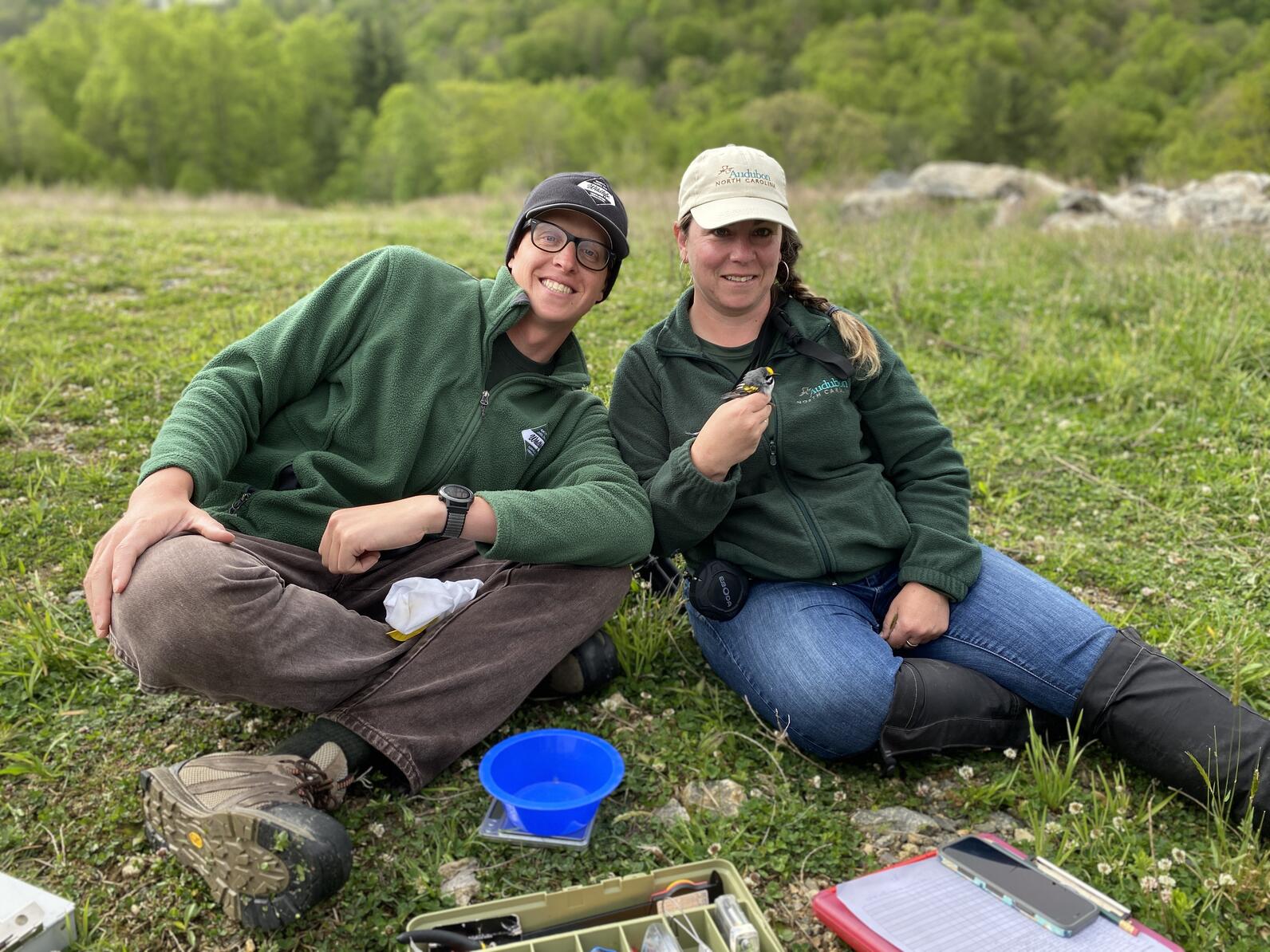
The secret is in the size of the radio trackers. Until recently, tracking technology was too large and bulky to be used on such small birds. As the technology has progressed and radio trackers have shrunk in size, researchers have seized the opportunity to begin following smaller songbirds, like warblers and sparrows.
The Golden-wing project is a collaboration with partners across the East Coast and Midwest, led by Amber Roth at the University of Maine. By using radio trackers, researchers will be able to collect an unprecedented amount of data, from the fine scale movements throughout their breeding territories鈥攊ncluding habitat in the North Carolina mountains鈥攖o their long-range migrations all the way to Central and South America.
Every ounce of weight is vital. One way the researchers cut down on weight is by using smaller batteries and extending their charge by programming the devices to turn on for just 12 hours a day, rather than around the clock.
Activating the tags at 10 p.m. will allows them to track nocturnal migration in the spring and fall, but it will also keep the device on during the morning hours, to collect data while the birds are moving around their nests to sing and gather food.
Each bird is weighed before the nanotag is attached. If a bird doesn鈥檛 weigh 8.5 grams鈥攁 little more than three pennies鈥攖hen it won鈥檛 be big and strong enough to carry the device, so it doesn鈥檛 get one.
The device sends out a radio signal, which is picked up in one of two ways. Researchers in the field can use portable antennas to track the birds; this is how Tomcho and other biologists will monitor the movement of Golden-wings on their breeding grounds.
Towers outfitted with radio receivers, known as Motus towers, can also pick up the signal of birds that pass by. The network of Motus towers continues to grow in North Carolina and across the globe, including a tower recently installed at 探花精选鈥檚 Lea Island sanctuary near Wilmington, funded by Cape Fear 探花精选 Society. The towers help pick up the broader, range-wide movements of a wide variety of species.
The Golden-winged Warbler research is just beginning, but those involved say it has already helped strengthen the connections between the network of people and organizations working to protect Golden-winged Warblers across their range. In North Carolina, partners include the NC Museum of Natural Sciences and UNC Wilmington.