

La p谩gina que intenta visitar s贸lo est谩 disponible en ingl茅s. 隆Disculpa!
The page you are about to visit is currently only available in English. Sorry!

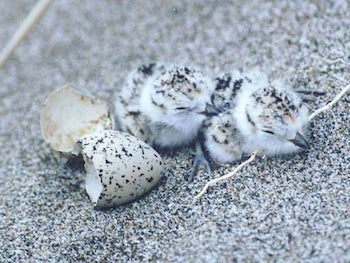
Snowy plover chicks. Photo: USFWS
What could be a greater contrast to last year鈥檚 massive, devastating oil spill than a snowy plover, no bigger than a fist, skittering hither and thither along a Gulf Coast beach. It鈥檚 a bird that weighs just two ounces as an adult, while an estimated 170 million gallons of crude gushed from the Deep Horizon well.
Though snowy plovers are found not just in the Americas, but also in the Old World, the U.S. population is a slim 17,000 or so. They exist only where there鈥檚 suitable habitat: beaches and flats that allow these quick striders, and their mottled eggs, to blend in. Along the Pacific, the Western snowy plover, a subspecies, is threatened under the Endangered Species Act. Around the Gulf, the population is larger, but still declining slightly. Fortunately, about 60 percent of nesting pairs use beaches along a 60-mile stretch of southernmost Texas, which didn鈥檛 see any oil. Had the spill happened there, what then?
But snowy plovers can be troubled not just by pollution, but by our mere presence: by development and general beach use, and now, around the Gulf, by spill mitigation efforts. 鈥淏ack on their traditional nesting grounds on the beaches and barrier islands this year, snowy plovers again face disturbance from cleanup activities where oil is still washing ashore or bubbling up through the sand,鈥� says Melanie Driscoll, 探花精选鈥檚 Direction of Bird Conservation for the Gulf of Mexico and Mississippi Flyway.
What鈥檚 worse, possibly, is if snowy plovers are feeding from soiled beaches. Says Driscoll, 鈥淲e fear that they are ingesting oil in the small crabs, shrimp, mollusks, and marine worms they eat as they race up and down our Gulf shores.鈥�
For more on the snowy plover, during the spill.