

La p谩gina que intenta visitar s贸lo est谩 disponible en ingl茅s. 隆Disculpa!
The page you are about to visit is currently only available in English. Sorry!

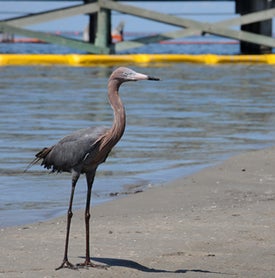
Photo: USCG/Patrick Kelley
Virtually wiped out by plume hunters a century ago, reddish egrets are slowly returning. About 12,000 live on the Gulf Coast in the U.S., a number small enough to be vulnerable. Oil spills in the Gulf pose a distinct threat to reddish egrets especially, because, unlike other heron species, they鈥檙e found only along coastal waters.
鈥淔ortunately, the reddish egret population in the Gulf, while low, is fairly stable, with most birds breeding in Texas and Florida where there was little direct oiling,鈥� says Melanie Driscoll, 探花精选鈥檚 Direction of Bird Conservation for the Gulf of Mexico and Mississippi Flyway. In Florida, they nest in mangroves, in mixed colonies, while in Texas, they take to cacti and willow, or even bare sand. 鈥淏ut oil in the food chain may harm them,鈥� says Driscoll, 鈥減rimarily in shallow, saline waters where submerged oil remains in mats that wash up onto nearby beaches.鈥�
Reddish egrets come in two distinct colors, or morphs: dark with a auburn head and neck, or white. When hunting, they鈥檙e entertainingly active, even acrobatic, known to dart and weave and kick up mud to confuse their aquatic prey. High-stepping through the shallows, they flap and shake their wings to startle and shepherd fish.
This 鈥渄ancing鈥� is a far cry from the usual sit and wait approach which herons make a virtue. But they鈥檝e also got patience, with an added flourish: They鈥檙e known for standing stock still with their wings raised overhead to make a large shadow on the water, free of glare, where fish take cover鈥攚rongly.
For more on the reddish egret, during the spill. And if you鈥檙e willing to risk a bit of dizziness, watch this three-minute video of a reddish egret dancing, one more reason why a major oil spill should never again be allowed to happen: