

La p谩gina que intenta visitar s贸lo est谩 disponible en ingl茅s. 隆Disculpa!
The page you are about to visit is currently only available in English. Sorry!

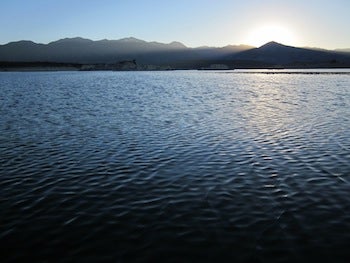
Photo: Nick Neely
Nestled in the high desert of eastern California, Mono Lake is 13 miles long, 7 miles wide and the hue of a robin鈥檚 egg. It has no outlet. In late-summer, up to 2 million eared grebes dive through its salty, alkaline water, their legs kicking up small splashes like frogs jumping from lily pads. Wilson鈥檚 and red-necked phalaropes lift off peeping, and form sinuous, shimmering flocks that, from a distance, appear suddenly as islets. California gulls bob here and there, thousands of them nesting on the actual volcanic islets at the lake鈥檚 center, where they feed their chicks slurries of brine shrimp. One of the most biologically productive lake鈥檚 on the planet, Mono feeds millions of migrating birds each year; and now, beneath its surface, another creature has been discovered that鈥檚 unlike any other life as we know it.
It was : NASA fellow and USGS scientist Felisa Wolfe-Simon isolated a bacteria from Mono that, in a lab, she gradually fed arsenic. Yet amazingly, the bacteria鈥攕train GFAJ-1 of the Halomonadaceae family of Gammaproteobacteria鈥攃ontinued to grow, incorporating this universal toxin (or so we thought) into its body in lieu of phosphorous, long considered one of six elements key to life. 鈥淭his is a microbe that has solved the problem of how to live in a different way,鈥� . Her experiment suggests there may be strains of life we don鈥檛 yet recognize (or waves of life, in the past); and that, as we peer into space in search of life, we may need to take a step back, catch our breath, and then broaden our lens.
It鈥檚 important to note, though, that GFAJ-1 only 鈥渟olved the problem of how to live in a different way鈥� for us in a controlled setting. Mono Lake has a relatively high arsenic concentration (17 parts per million, at the lake's lowest level, is a lot when compared with the EPA鈥檚 standard of .01 ppm for drinking water), but GFAJ-1 doesn鈥檛 subsist on arsenic 鈥渋n nature.鈥� Nonetheless, the experiment demonstrates that a biological system/cell could 鈥渕anage a weak link鈥� (in this case, an absence of phosphorous), as chemist Steve Benner explained yesterday at a NASA press conference. The bacteria grew more slowly overall on an arsenic diet, but it managed. 鈥淚t鈥檚 like if you or I morphed into fully functioning cyborgs after being thrown into a room of electronic scrap with nothing to eat,鈥� Caleb Scharf, a Columbia University astrobiologist, told the New York Times.
Almost as remarkable, perhaps, is that, in the early 80s, Mono Lake鈥檚 ecosystem nearly collapsed. The City of Los Angeles began diverting four of Mono Lake鈥檚 five main creeks in 1941 and, over the course of 40 years, the lake dropped 45 feet, increasing in salinity to the point where its brine shrimp almost couldn鈥檛 survive. The 探花精选, along with , brought suit, and in 1983 the California Supreme Court ruled it was the state鈥檚 duty to safeguard the environment for all, even if that meant a shuffling of once-inviolable water rights. This was an unprecedented decision, a landmark for the environmental movement, and Mono's level was stabilized. Mono Lake is a windswept, austere place, but it鈥檚 anything but alien. It鈥檚 essential to birdlife and, it seems, to undiscovered wonders.
Upon hearing this news, many will look to the night skies, to Mars and beyond. But what the GFAJ-1 bacteria also signals is that we should redouble our efforts to protect the environments on this planet; obviously, we鈥檙e still getting to know them. Though this particular arsenic-tolerant 鈥渆xtremophile鈥� might have survived in Mono Lake had it dropped further, Mono's brine shrimp would have died, and the birds that feed on them would have been displaced. Who knows what else might have been lost.