

La p谩gina que intenta visitar s贸lo est谩 disponible en ingl茅s. 隆Disculpa!
The page you are about to visit is currently only available in English. Sorry!

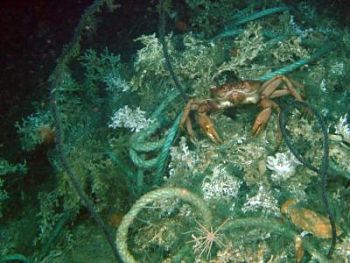
An entangled trawl in Northeast Atlantic cold corals. Credit: Jason Hall-Spencer
At 500 meters below the sea, it is utter darkness. All sunlight is blocked, and temperatures in the impenetrable murk hover at one or two degrees above freezing. If a human dared venture to these depths, the air would be squeezed out of her lungs before she had a chance to survey her surroundings. But if she did get a look around, she would find a rich and intriguing community of mostly small, slow-moving, slow-growing animals specially adapted to the ocean floor.
Living at an average of 3,800 meters below the sea, bottom-dwelling creatures have to be tough to eke out a living. To eat, they must sit and wait for chance food particles to trickle down from the surface. Chemical navigational cues replace eyes made useless by the darkness. Some use to seek out mates. Despite these challenges, a plethora of cool critters thrive on the ocean floor, creating diverse and mysterious, little-known habitats. Added to nature鈥檚 challenges, though, are human impacts. Not surprisingly, in such an already hostile environment, human impacts are causing some of these fascinating creatures to teeter dangerously close to extinction.
Over 20 deep-sea experts from around the globe combined their expertise to analyze the greatest threats to bottom-dwelling biodiversity. Their results, in PLoS ONE, took into account past, present, and future impact scenarios in habitats at the highest risk for biodiversity loss, like submarine canyons and cold-water coral reefs. As usual, human meddling with the environment manifested itself in a variety of forms on the ocean floor, including pollution, resource exploitation, and climate change.
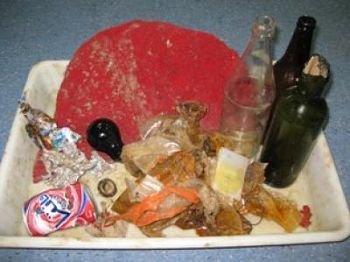
Litter collected 2,000 meters below the Mediterranean Sea. Credit: Ramirez Llodra
People have been using the oceans as a garbage disposals ground for years. Prior to 1972, countries like the United States actively used the deep sea floor as a dumping ground. Because of the cold temperatures and low biological productivity, much of the pre-1972 garbage lingers on, including 55-gallon drums disposed of by the U.S. military. Dumping garbage onto the ocean鈥檚 floor 鈥渋s like putting things into a refrigerator,鈥� says Cindy Van Dover, an oceanographer at Duke University and one of the study鈥檚 authors. Luckily, the international community banned ocean dumping at the , but remnants of the irresponsible practice linger on. 鈥楳ermaid tears,鈥� or tiny bits of degraded plastics, are a particularly worrisome since animals can ingest them, though researchers still don鈥檛 know what consequence mermaid tears will have on deep-water creatures. Despite the 1972 legislation, approximately 6.4 million tons of trash鈥� including illegal dumping from ships, trash run off from rivers and shores, and accumulation of industrial chemical pollutants like mercury and lead鈥攕till finds its way into the ocean each year, and much of it sinks to the bottom.
But the largest impacts to the deep sea seem to come from the common oceanic lament of over-fishing. Deepwater fishers exploit species like the , a fish that takes decades to mature. And in harvesting such animals, fishermen not only disrupt the replication of a slow-maturing species, they also wreck havoc to the sometimes century-old deep-sea coral beds through destructive trawling. Fishers deliver a final blow with what is referred to as 鈥榞host fishing,鈥� or nets that have detached from boats which continue to claim aquatic lives. As the tattered webs aimlessly drift along the ocean floor, they wastefully ensnare and kill creatures like crabs.
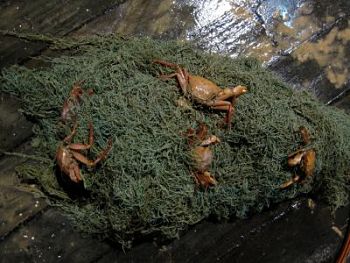
Dead Geryon crabs entangled in a trawl net found 1,200 meters below the Mediterranean Sea. Credit: Ramirez Llodra
Mineral extraction from hydrothermal vents鈥攔ecently only a twinkle in mining companies鈥� eyes鈥攏ow also seems to be approaching a reality. Pilot projects and environmental impact assessments have already been carried out in ocean patches near Papua New Guinea, and mining for copper and other metals is expected to begin within the next year or so in that location. Scientists have no idea what the impacts of such mining will be, or how long it will take for the ocean floor to restore itself after the damage is done.
In the coming years, scientists predict the impacts of climate change will reach the ocean depths. Ocean acidification, which will start on the surface waters, will eventually permeate to the seafloor. Any increase in temperature can cause changes in the water column鈥檚 chemistry, the ocean鈥檚 circulation, and the distribution of nutrients and oxygen essential for deep-sea animals鈥� survival. Depressingly, all of these factors鈥攍itter and chemical accumulation, over-fishing, resource extraction, and climate change鈥攚ill most likely act synergistically to create compound impacts to ocean bottom communities.
And it doesn鈥檛 help that our knowledge of the deep sea is still abysmal, complicating researchers鈥� abilities to accurately predict future impacts or design ways to avoid them. The deep seafloor covers about 73 percent of the oceans, or 326 million square kilometers. Only the equivalent area of a few football fields has ever been sampled biologically, making this underwater kingdom the largest ecosystem on our planet but one of it鈥檚 least-studied. But thanks to recent technological developments, the ocean floor is becoming more accessible. 鈥淎lmost every year a dogma we鈥檝e had about the deep ocean changes,鈥� Van Dover says. Scientists who venture to a new corner of the ocean can find out whole new things about how the ocean works and discover entire families of new animals, she says. In this 鈥榣ast great wilderness,鈥� opportunities for discovery seem limitless, but scientists worry that the rate at which these discoveries occur may be outpaced by their decline.
Still, all is not lost. Though ocean fisheries have undoubtedly gotten out of hand, Van Dover hopes that new technologies and appropriate regulations can allow scientists, policy-makers and industries to work together in undertaking activities like mineral extraction. She thinks the Papua New Guinea site can serve as an initial test for future mining events, aiding scientists in understanding the impact of deep-sea mining and the rate of recovery for the delicate ecosystems.
While anyone can fly over a terrestrial ecosystem and see what鈥檚 happening, Van Dover says, scientists don鈥檛 have that option when it comes to the ocean floor. In such a difficult environment to study, Van Dover considers, 鈥渉ow will we know what has been done until long after it鈥檚 over?鈥� But she is optimistic that so long as science, technology, regulation, and exploitation go hand-in-hand, things can be done right. 鈥淚t鈥檚 an interesting time for building a better knowledge for how seafloor biosphere components work,鈥� says Van Dover.
See also: ,, ,