

La p谩gina que intenta visitar s贸lo est谩 disponible en ingl茅s. 隆Disculpa!
The page you are about to visit is currently only available in English. Sorry!

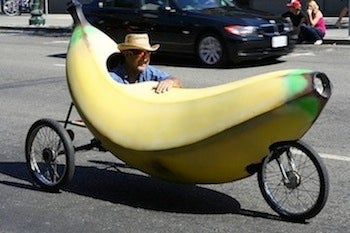
Photo: ImipolexG, Creative Commons License
Several weeks ago, there came a flash of breaking news on that silent monitor which, in this day and age, has replaced cheesy music in elevators: Del Monte to individually wrap bananas. Wait a sec, anyone who glimpsed this headline quickly thought: Isn鈥檛 a banana already delivered in a bag, one called 鈥渁 peel鈥�?
The media, of course, went slightly ape. Comedian , inducting it into his "Pantry of Shame" while introducing his own product, a competitor: the coconut case, designed to protect a coconut. Shortly thereafter, : A wrapper, they argued, would suspend ripening, not only reducing spoilage, but also allowing school children to buy bananas, instead of chocolate bars, from vending machines everywhere. This wrapper will fight obesity and shrink our collective carbon footprint, and it's recyclable to boot!
As the lyricist Ira Gershwin once almost wrote, You eat bananas, I eat banahnahs, and a few will use them to solve global problems. First, there was which can鈥檛 be understated. Then, a few weeks ago, a study confirmed that , removing heavy metals like lead that can damage the brain. Apparently, they鈥檙e full of negatively charged ions, which attract positively charged metals. So all you have to do is dry your peels, mince them finely, and press the water through. Sixty percent of heavy metals are removed on the first pass, and almost all if the water鈥檚 treated multiple times. The material can also be used up to 11 times before it鈥檚 saturated, which makes it a potentially useful tool in industrial settings. Pretty cool.
But bananas aren't done, not nearly: , or at least some of a vehicle's components. Nano-cellulose fibers from banana trees and other fruits can produce a plastic that鈥檚 three or four times stronger, 30 percent lighter, and more fire resistant than the petroleum-based stuff currently in use. 鈥淲e believe that a lot of car parts, including dashboards, bumpers, side panels, will be made of nano-sized fruit fibers in the future,鈥� said researcher Alcides Le茫o, in a press release on Sunday. 鈥淔or one thing, they will help reduce the weight of cars and that will improve fuel economy."
How does it work? Banana leaves鈥攁nd peels?鈥攁re put into something not unlike a pressure cooker. Chemicals (eek) are added, and the mixture is heated in cycles. Eventually, you鈥檙e left with a fine powder, each pound of which can produce 100 pounds of dashboard. Seems like may have some competition, suddenly, as auto manufacturers are already testing out those banana bumpers.
What does it all mean? Perhaps there really is a way we can eat and have our clean water, cars, and consciences, too. Or at the very least, maybe bananas will someday be used to make super-strong, fire-resistant plastic wrappers to wrap our bananas in.
And that's where I鈥檒l call this whole thing off.