

La p谩gina que intenta visitar s贸lo est谩 disponible en ingl茅s. 隆Disculpa!
The page you are about to visit is currently only available in English. Sorry!

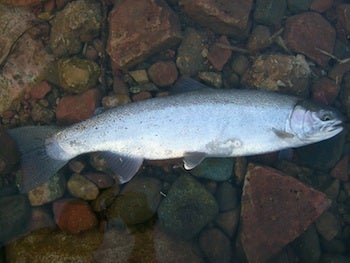
Courtesy Fungus Guy, via Wikimedia Commons
Anglers know that aren鈥檛 quite like rainbow trout鈥攖hey鈥檙e enormous, reaching up to 55 pounds! But in fact, these ocean-running, rod-debilitating, aquatic gorillas of the Northwest are indeed rainbows, Oncorhynchus mykiss. That some members of this species rove the sea for years and become giants before returning to their birth streams to spawn, while others live quieter, local lives in freshwater, is an enigma. Depending on environmental cues like water temperature and food availability (factors we don鈥檛 fully understand), it seems any combination of parents鈥攖wo trout, two steelhead, or a steelhead and a trout鈥攃an produce either form.
Now researchers at Oregon State University have added further intrigue to this mystery by discovering that steelhead and their smaller counterparts mingle (wink, wink) quite a lot: On , a tributary to the mighty Columbia, 40 percent of returning steelheads鈥� genes are derived from rainbow trout, not steelhead parents. 鈥淲hat鈥檚 particularly remarkable is the extent to which they interbreed,鈥� says Mark Christie, a fish geneticist and coauthor of .
To spawn, steelhead dig 鈥渞eds,鈥� small nests in the gravel of the riverbed, where the females lay 3,000 or 4,000 eggs. Then, males fertilize the nest and stand guard, chasing off other steelhead. But some 鈥渟neaker鈥� rainbow trout males can slip in under the watch of a massive male steelhead, and surreptitiously leave milt. (In fact, steelhead may not always recognize trout as potential competitors, Christie says.) Much of wild trouts' genetic contribution to steelhead likely occurs this way.
For their study, the OSU researchers took advantage of a problem Hood River steelhead confronted: , but it was also a convenient checkpoint for a quick genetic test. , and so, with a tiny clip of the fin, each and every steelhead could be sampled. Back in the lab, DNA analysis showed if a particular steelhead鈥檚 parents were already in the database, or if they were unknown鈥攊.e. a wild trout upstream. The study examined more than 12,000 steelhead over the course of 15 years.
Another notable finding was that just 1 percent of Hood River steelheads鈥� genes come from 鈥渞esidualized鈥� hatchery fish鈥攖hat is, fish born from steelhead in a hatchery that, oddly enough, don鈥檛 turn out to be steelhead once released, but rather remain in freshwater and stay small. Fish biologists and managers worry about strays from hatcheries mating with wild strains, because it reduces the ecological fitness of native fish: wild steelhead need to be equipped to meet the challenging conditions of a river, not concrete pools (where they鈥檙e fed by machines, and so on). You may have several years ago. But Christie鈥檚 team found 鈥渢here鈥檚 very little genes being contribute by these hatchery fish, which highlights that these wild, resident trout are really important as a genetic buffer for the entire steelhead population.鈥�
The implications? Well, to start, the Northwest鈥檚 iconic salmon, also embattled ocean-going lunkers, have no such buffer. What鈥檚 more, up and down the West Coast 鈥攂ut listed just as 鈥渟teelhead.鈥� 鈥淚n some populations,鈥� Christie says, 鈥渋t may be prudent to grant some protection to rainbow trout as well.鈥�