
La p谩gina que intenta visitar s贸lo est谩 disponible en ingl茅s. 隆Disculpa!
The page you are about to visit is currently only available in English. Sorry!





It was early summer when Kate Edwards had nest boxes installed in her yard in San Antonio, Texas. A pair of House Sparrows immediately moved in. Soon enough, the plastics followed.
When Edwards checked on her new neighbors, she saw the sparrows had woven their nests from whatever materials they happened to find nearby, which included pieces of grass and long plastic strips. 鈥淚t was eye-opening to see,鈥� Edwards says. 鈥淥nce we started peeking through the nests, it was like, 鈥極h, there鈥檚 a big old piece of plastic right there.鈥欌�� But she was more concerned about harder-to-spot debris, like plastic traces the chicks could ingest from the food their parents gathered.
Edwards, a lifelong nature lover, was newly clued in to these hidden threats as a volunteer for the Avian Microplastics Study. The community science initiative aims to measure just how much microplastic pollution shows up in the city鈥檚 songbirds, which could, in turn, offer insights for the health of their human neighbors.
By definition, microplastics are tiny, no more than five millimeters wide鈥攁bout the width of a pencil eraser. The plastic bits typically shed from synthetic fabrics, worn-down tires, or degraded waste like bottles and bags. When they enter waterways, air, and soil, their small size accelerates their spread far and wide. An increasing number of studies point to their ubiquity across all kinds of ecosystems, from Arctic sea ice to deep-sea trenches.
Microplastics are also present in the bodies of people and wildlife, and though scientists are still working to understand their health effects, evidence so far shows cause for concern. In birds, microplastics have been found to , , and scar the stomachs of shearwaters.
Most of the past research has focused on aquatic ecosystems and waterbirds, says Wieland Heim, an ornithologist at the University of Oldenburg in Germany who has studied the high rates of microplastics in ducks. 鈥淏ut now there鈥檚 growing evidence that we can find it in soil, in every plant,鈥� Heim says. 鈥淪o it鈥檚 very likely that terrestrial animals are also affected.鈥�
The , led by Texas researchers through the Urban Bird Project, aims to fill in some of those gaps by examining plastic pollution in urban songbirds and their nests. Over the past two years, project leader Mariel Ortega, a graduate student at the University of Texas at San Antonio, has installed about 150 nest boxes, scattered around her school鈥檚 campus and on the properties of volunteers like Edwards.
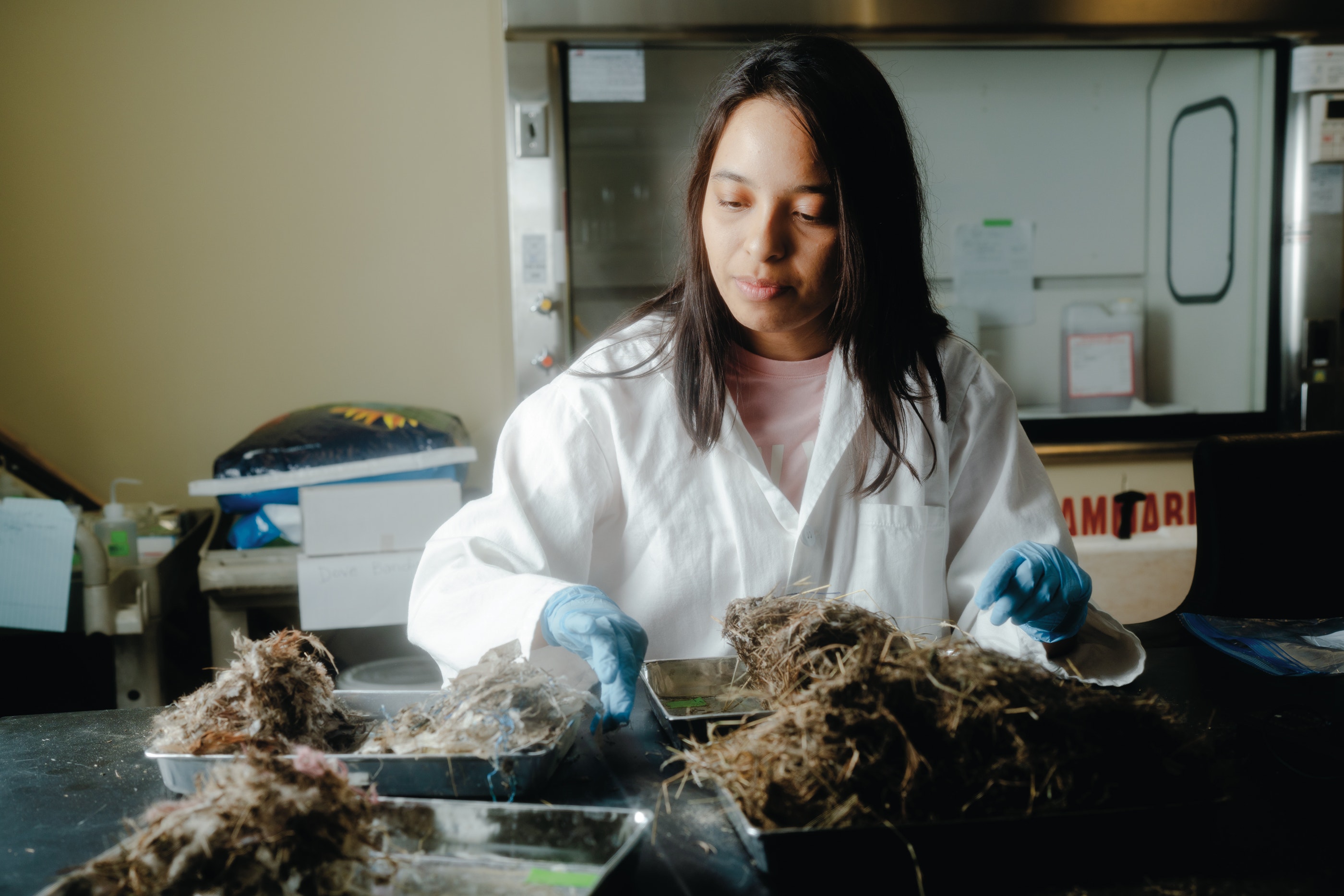
When any of four species鈥攖he House Sparrow, Black-crested Titmouse, and Bewick鈥檚 and Carolina Wren鈥攎ove in, volunteers notify Ortega. She stops by when the chicks are around 10 days old to collect their fecal sacs (or, as she calls them, 鈥渓ittle bird diapers鈥�), which she鈥檒l bring back to the lab to analyze how much plastic the baby birds are excreting. Ortega also measures their leg bones and weight to assess how quickly the chicks are growing. Once the breeding season ends and the birds depart, she combs through the leftover nesting material for plastic.
The initial results show that many San Antonio songbirds are ingesting microplastics, including the chicks that hatched in Edwards鈥檚 yard. Ortega is now investigating what kinds of plastic materials are present to pinpoint sources of pollution, as well as analyzing whether higher levels of exposure affect the chicks鈥� health.
Ortega and her collaborator, avian ecologist Jen Smith, also hope their data can uncover whether plastic pollution is spread unevenly across neighborhoods. Inequities in urban planning and waste management can saddle marginalized communities with more highways, landfills, and overflowing 颅dumpsters鈥攁ll of which are sources of microplastics. To see whether that pattern holds in San Antonio, the researchers recruited volunteers from areas on both ends of the socioeconomic spectrum. Revealing whether some neighborhoods face higher levels of plastic exposure could help cities craft more equitable policies, Smith says.
Researchers around the world are turning to birds to investigate similar questions. For instance, Imogen Mansfield, an environmental scientist at England鈥檚 University of Birmingham, is sampling Blue Tit and Great Tit nests to learn whether plastic pollution is greater in denser urban areas. Birds, she says, offer a simple yet effective way to get a snapshot of the environment, since they live in a wide variety of habitats and eat a range of foods.
More scientists are also engaging local volunteers to contribute to those efforts, says Mansfield. 鈥淐ommunity-led science can have a great impact on advancing microplastic pollution research,鈥� she says. Heim, in Germany, is one of them. In order to understand how microplastics are distributed along migratory flyways, he鈥檚 planning to enlist bird banders (or bird ringers, as they鈥檙e called in Europe) across the continent to help him collect fecal samples from songbirds.
For Edwards, collaborating on the Avian Microplastics Study helped instill a newfound appreciation for familiar House Sparrows. It has also spurred her to contemplate how closely her own well-being is linked to that of the species around her. Recognizing these connections will be crucial for understanding the growing problem of microplastics and cleaning it up. 鈥淚t鈥檚 not just helping the birds,鈥� Ortega says, 鈥渂ut also all people who are sharing the same resources.鈥�
This story originally ran in the Winter 2025 issue as 鈥淢aterial Evidence.鈥� To receive our print magazine, become a member by .