Atlantic Puffin
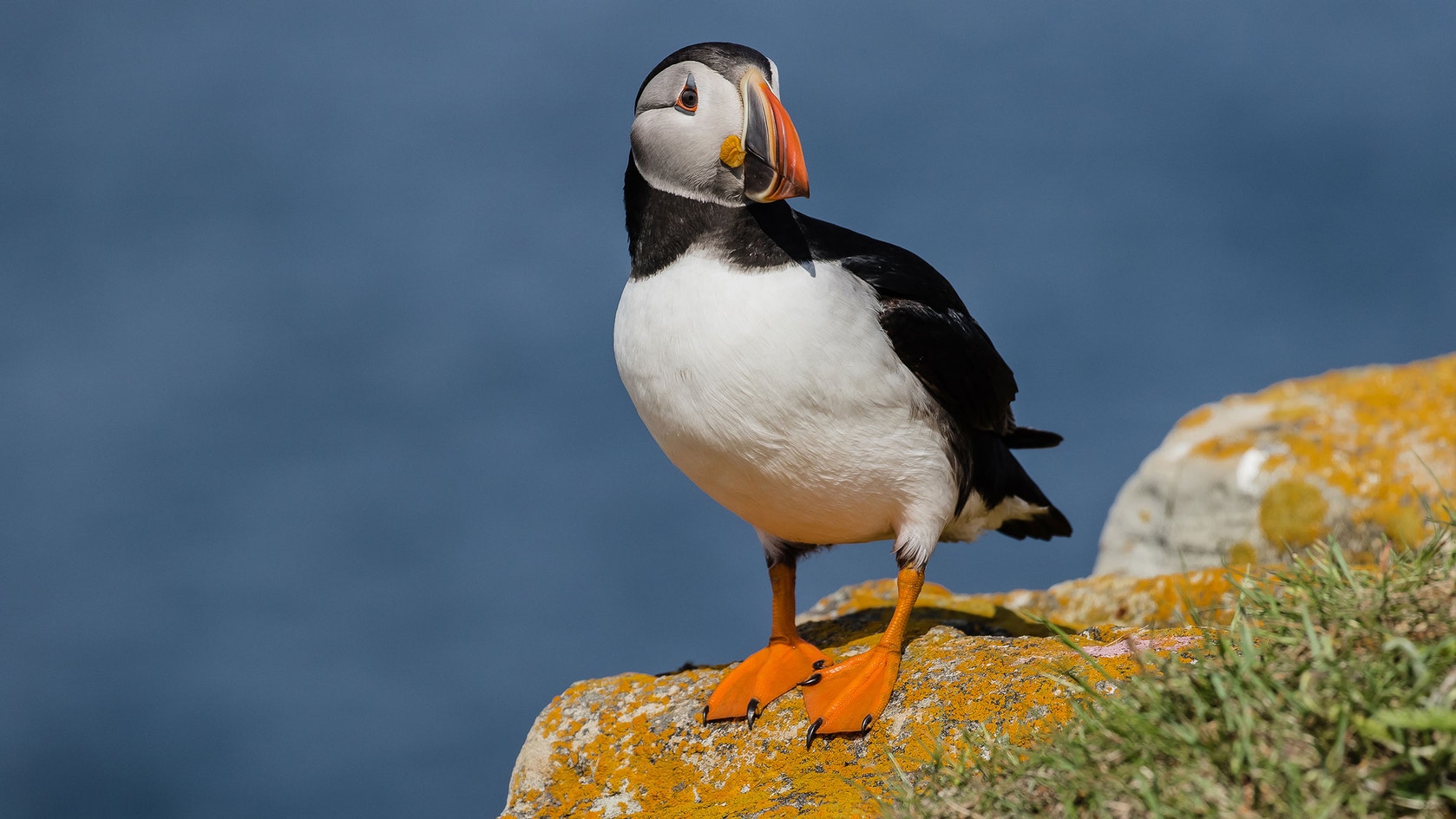











Atlantic Puffin
Fratercula arctica
At a Glance
Nesting around the edges of the North Atlantic, the Atlantic Puffin is sought after by birdwatchers who visit Maine or eastern Canada in summer. At its colonies, the bird may fly back to its nest carrying a dozen small fish lined up in its bill, making us wonder how the puffin holds onto ten slippery fish while grabbing two more. Gregarious at its nesting sites, the Atlantic Puffin is often solitary in winter, far from land on the open ocean.
All bird guide text and rangemaps adapted from by Kenn Kaufman漏 1996, used by permission of Houghton Mifflin Harcourt Publishing Company. All rights reserved.
Category
Auks, Murres, Puffins, Upright-perching Water Birds
IUCN Status
Vulnerable
Habitat
Coasts and Shorelines, Open Ocean
Region
Eastern Canada, Mid Atlantic, New England
Behavior
Direct Flight, Erratic, Rapid Wingbeats, Swimming
Population
12.000.000
Range & Identification
Migration & Range Maps
In North American waters, the Atlantic Puffin winters from the edge of pack ice south to Maryland, far offshore, mostly just seaward from edge of continental shelf. It has strayed south to Florida. European birds may move into warmer waters, reaching western Mediterranean and northwest Africa. The Atlantic Puffin is capable of moving long distances; young birds banded in Iceland and Europe have been recovered in eastern Canada.
Description
Sexes similar 鈥� Length: 10鈥�13 in (25鈥�33 cm); wingspan: 18 in鈥�2 ft 1 in (47鈥�63 cm); weight: 11鈥�19 oz (310鈥�550 g). Atlantic Puffin summer adults are unmistakable (no range overlap with other puffins). In winter, the bill is somewhat smaller and less colorful (after outer plates are shed), face is grayer. Immature Atlantic Puffin has smaller bill, but still recognizably different shape from other auks in Atlantic.
Size
About the size of a Crow
Color
Black, Orange, Red, White, Yellow
Wing Shape
Pointed, Tapered
Tail Shape
Short
Songs and Calls
The Atlantic Puffin produces deep throaty purrs and croaks.
Call Pattern
Falling, Flat, Rising, Simple
Call Type
Croak/Quack, Odd
Habitat
Coastal and offshore waters, open sea. Colonial; the Atlantic Puffin breeds in burrows and among rocks of sea islands. Favors cool or cold waters off North America. Outside of breeding season the Atlantic Puffin is usually well offshore, even far out in mid-ocean. Nests on islands where nesting sites provided by soil for burrows or crevices among rocks.
Sign up for 探花精选's newsletter to learn more about birds like the Atlantic Puffin
Behavior
Eggs
One (rarely 2, probably laid by 2 females). White, sometimes faintly marked with brown, purple. Incubation is by both sexes (female may do more), 36-45 days, usually 39-42.
Young
Both parents feed nestlings, carrying fish in bill; may feed fish directly to young at first, later dropping them on floor of nest. The young Atalntic Puffin leaves the nest usually 38-44 days after hatching; usually leaving at night and flying directly out to sea.
Feeding Behavior
The Atlantic Puffin forages while swimming underwater. It does most foraging within 50 ft of the surface, but can dive to about 200 ft.
Diet
Fish, crustaceans. Food is brought to young in nest, mostly small fish, especially sand lance, herring, capelin, cod, many others. The diet of Atlantic Puffin adults (especially in winter) is poorly known; in addition to fish, it may include many crustaceans (such as euphausiid shrimp, mysids, copepods) as well as mollusks and marine worms.
Nesting
The Atlantic Puffin usually first breeds at about 5 years. Breeds in colonies and birds often have same mates each year. In courtship, the male repeatedly flicks head up and back so that bill points up; may continue for minutes. Members of a pair swing bills sideways, clashing them together repeatedly. The Atlantic Puffin nest site is in burrow 3-7 ft long, or in natural crevice or under rocks. Sometimes one entrance leads to side branches and multiple nests. Both sexes help excavate. Nest in chamber in burrow usually has sparse lining of grass, feathers.
Conservation
Conservation Status
The Atlantic Pufin saw major declines during 19th century owing to overharvesting of eggs and adults. During the 20th century they continued to decrease at the southern end of breeding range in both North America and Europe. The Atlantic Puffis is vulnerable to the introduction of predators (such as rats) to nesting islands. An ambitious 探花精选 project to re-introduce the Atlantic Puffin on former nesting islands off Maine, started in the 1970s, has been a major success. However, at the southernmost colonies, the Atlantic Puffin has poor breeding success in warm-water years, which are becoming more frequent as the climate heats up.
